

Modeling Binary Systems That End in Stellar Mergers and Give Rise to Gravitational Waves - MOBY, reg. no. 7337
In the spirit of the increasingly intensive exploration of the Universe, which scientists across the globe are passionately pursuing, a team of researchers from Serbia has decided to attempt to replicate the evolution of massive binary stars, potential sources of gravitational waves.
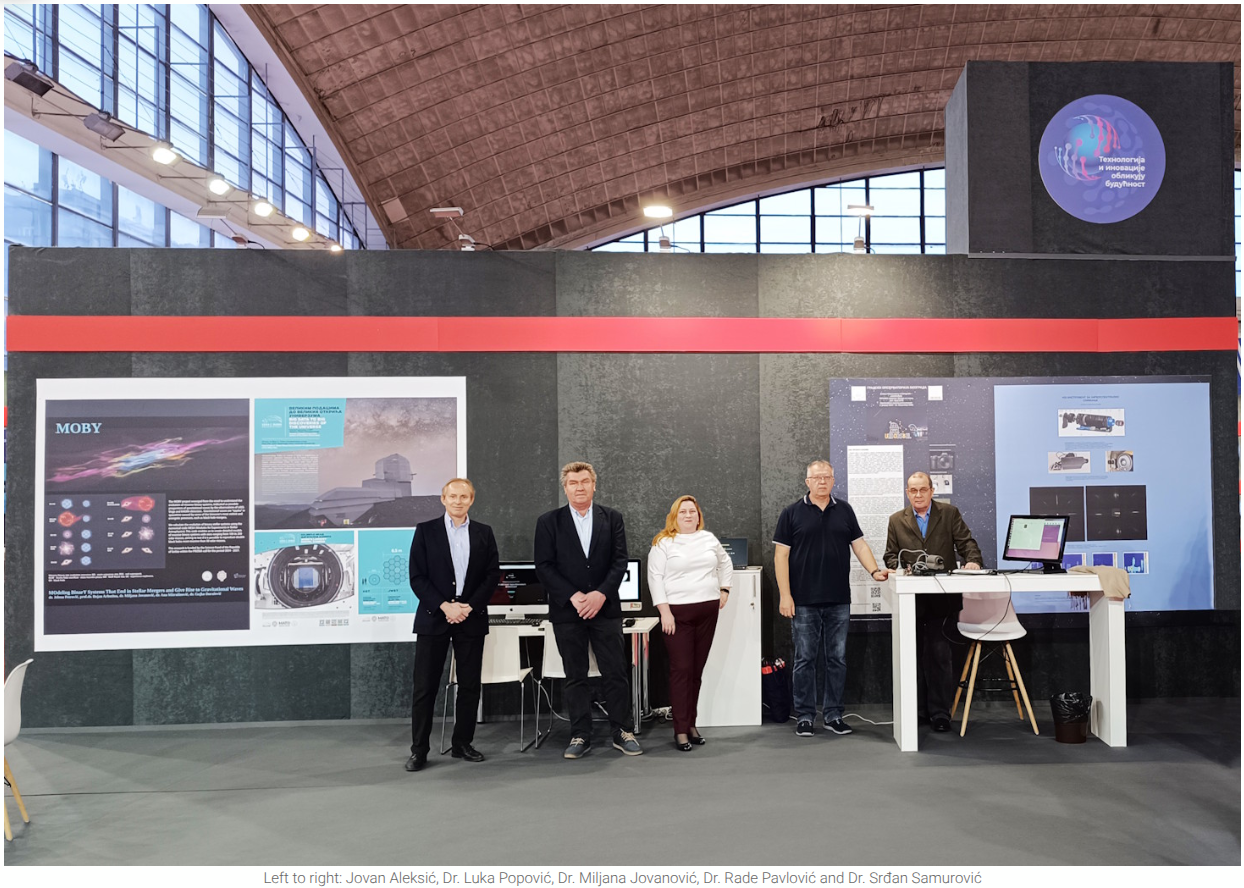
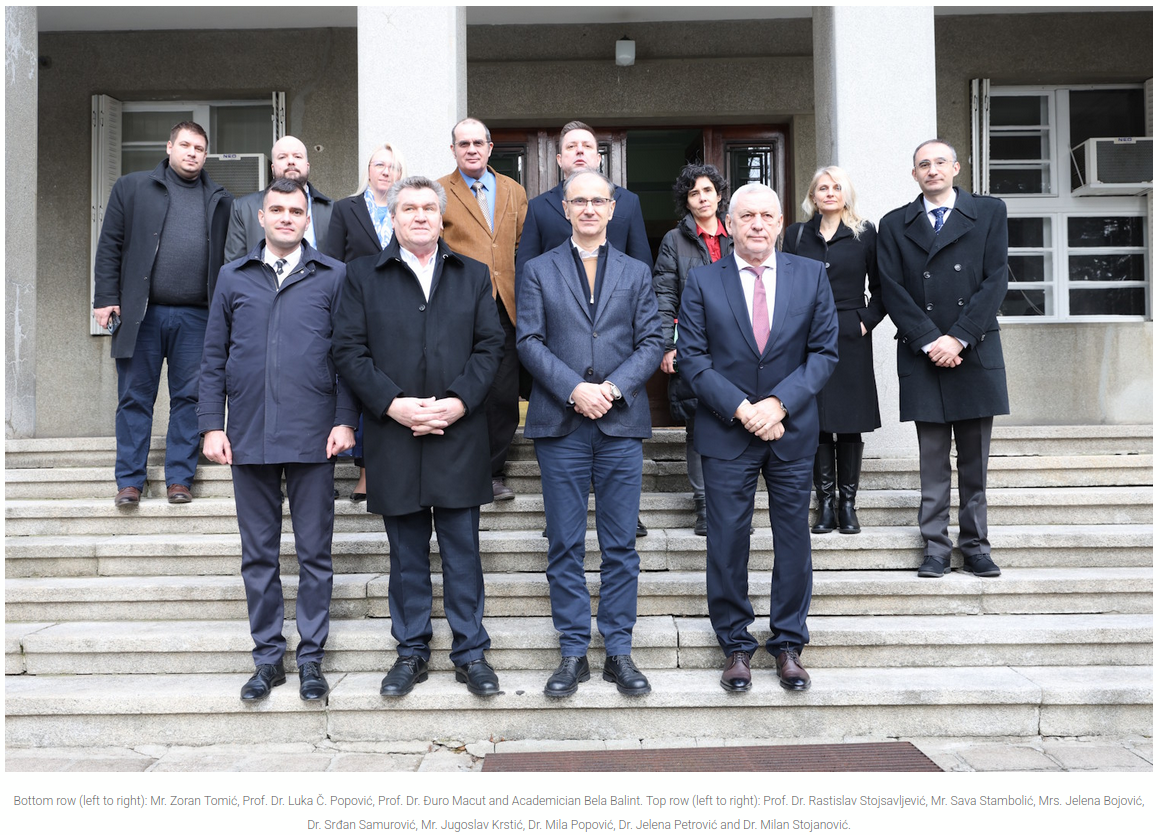
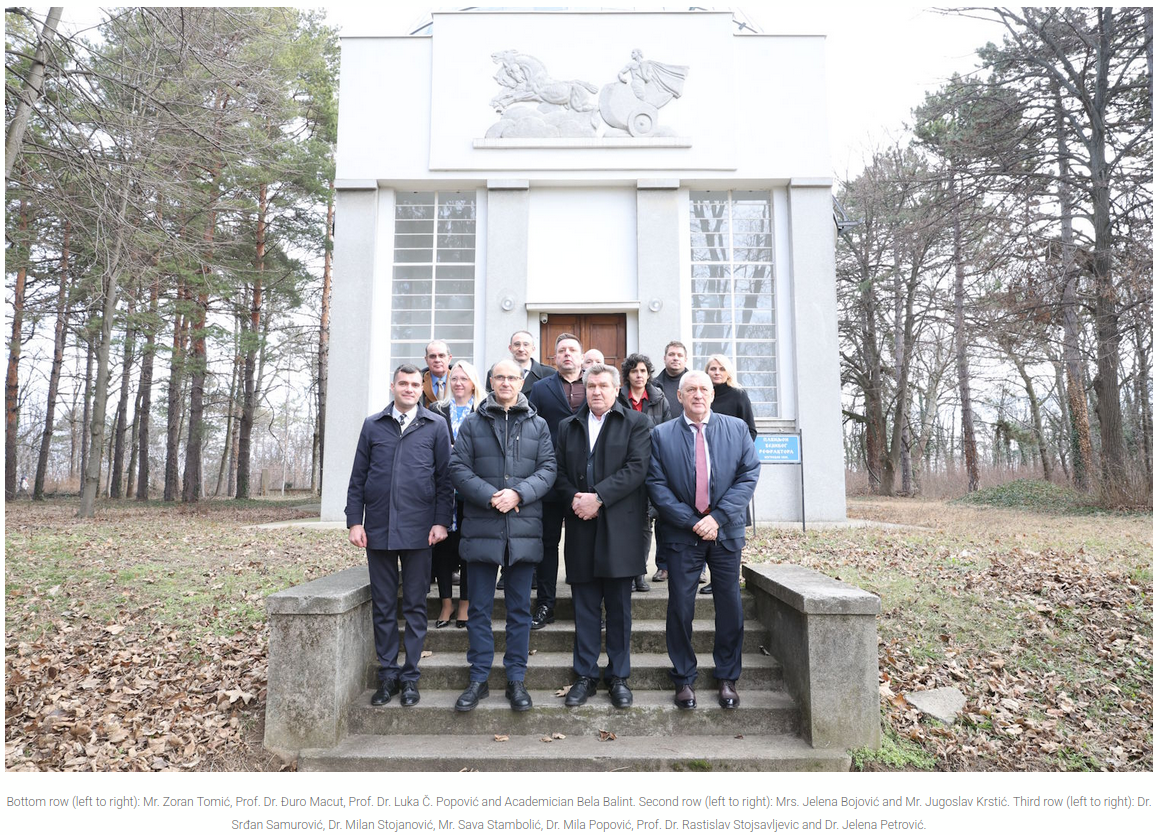
Led by Dr. Jelena Petrovic, a scientific advisor at the Astronomical Observatory in Belgrade, Serbia, this five-member team will study binary systems under the project acronym MOBY (MOdeling BinarY Systems That End in Stellar Mergers and Give Rise to Gravitational Waves), funded by the Science Fund of the Republic of Serbia from 2024 to 2027.
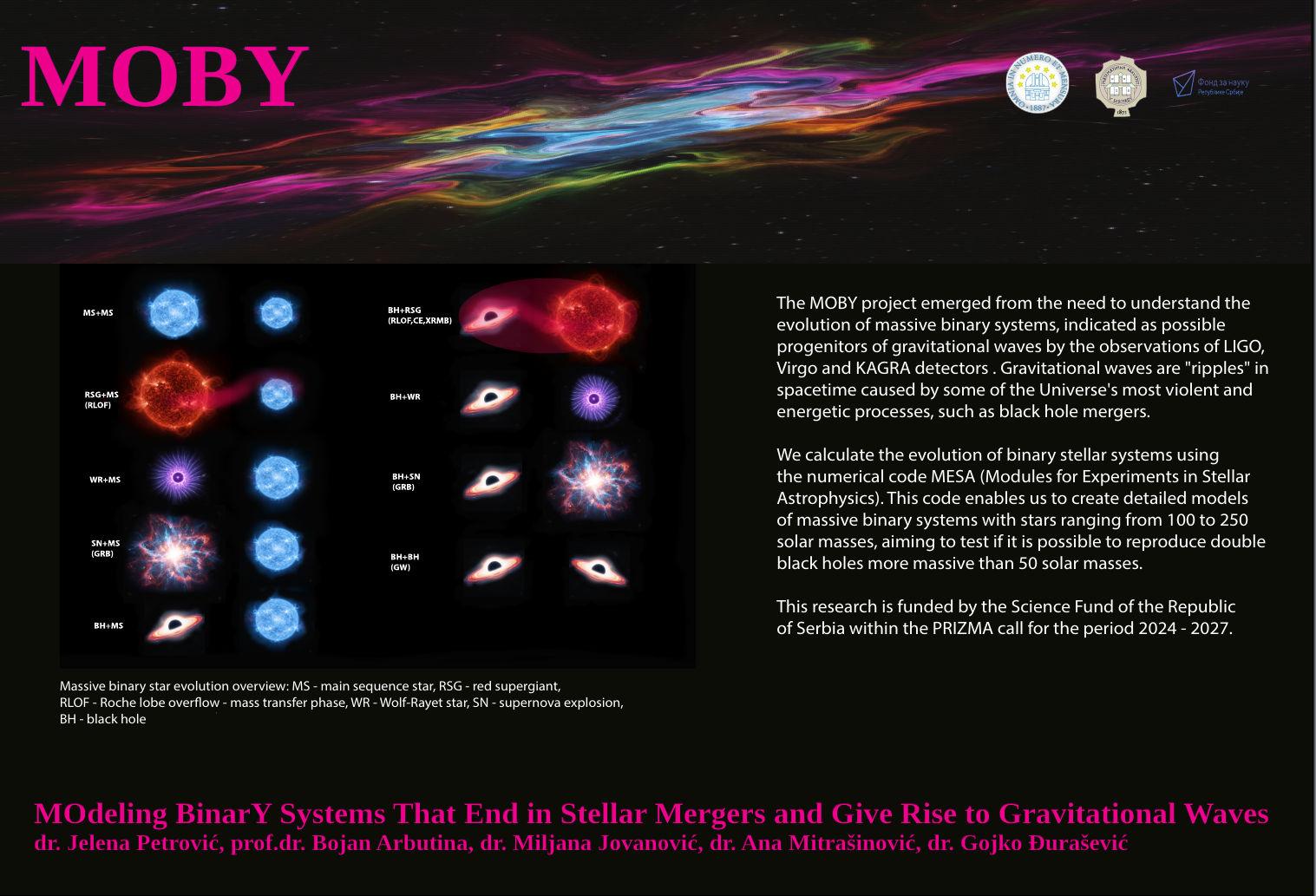
The MOBY project emerged from the need to understand the evolution of massive binary systems, as progenitors of gravitational waves. Gravitational waves are "ripples" in spacetime caused by some of the universe's most violent and energetic processes, first predicted by Albert Einstein in 1916 in his General Theory of Relativity.
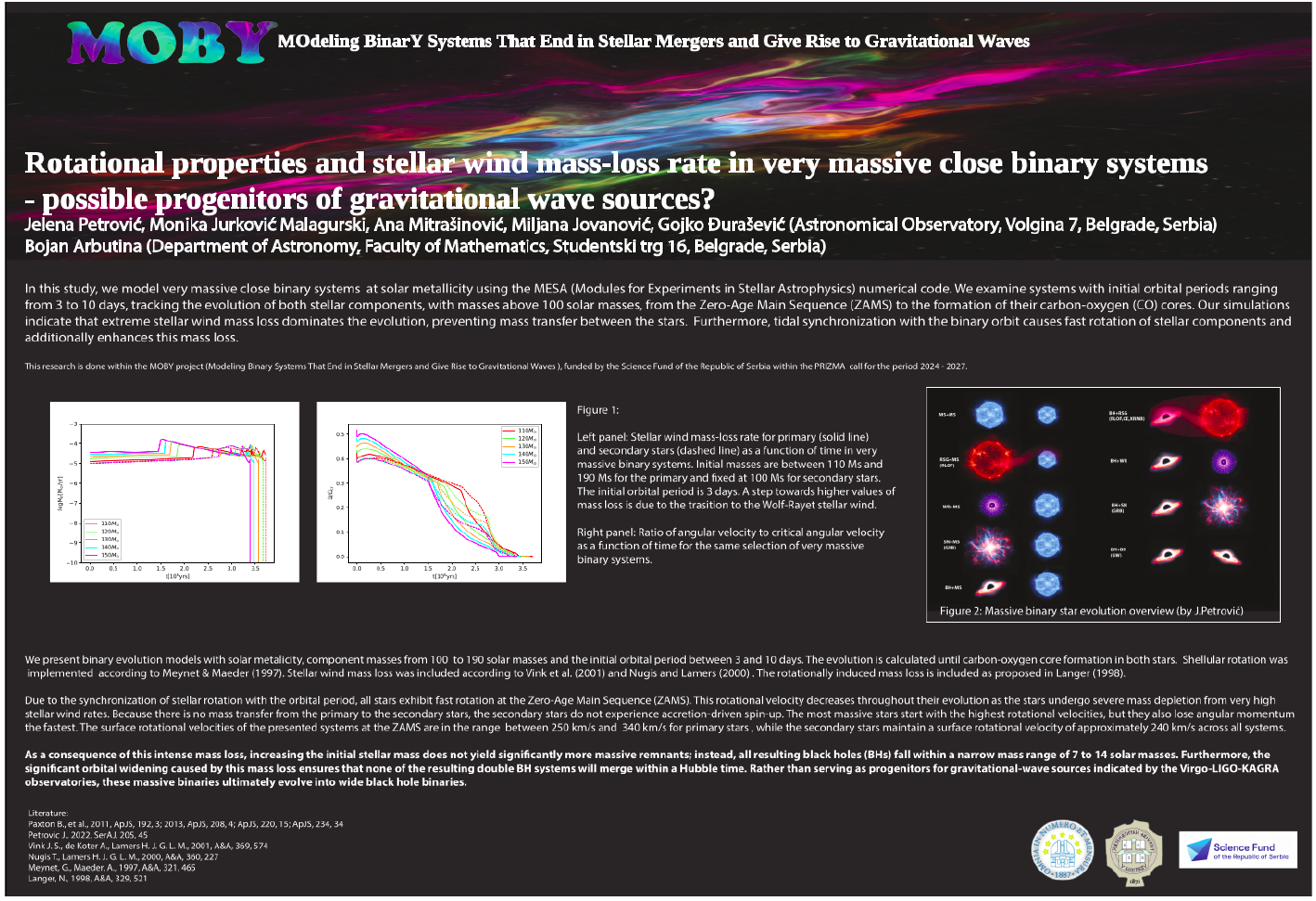
The research team will simulate the evolution of such stellar systems using the numerical code MESA (Modules for Experiments in Stellar Astrophysics). This code will allow them to create detailed models of massive binary systems with stars ranging from 100 to 250 solar masses, aiming to reproduce resulting black holes with masses exceeding 50 solar masses.
The primary focus of the research will be on close binary systems with varying metallicities. Astronomers refer to all elements heavier than hydrogen and helium as "metals," and metallicity is defined as the metal or heavier element content in a star. This study will consider stars with diverse metal levels.
By using the MESA evolution code, the research team will calculate around 1,000 different binary system models with various initial parameters. When scientists determine the carbon-oxygen core masses in these stars and infer the expected black hole final masses, they may also explain the dependence of these masses on the initial parameters of the modeled systems.
First and foremost, it's important to understand that the project team will simulate the evolutionary process of close binary stellar systems up to the stage of massive binary black holes.
These systems start their lives as hot blue-white stars with surface temperatures exceeding 30,000 Kelvin (K). They continue their life path by evolving into Wolf-Rayet+O binary systems through mass transfer. Eventually, after two supernova explosions, they conclude as compact binary systems consisting of two black holes.
Observations by the LIGO and Virgo gravitational wave detector collaborations have established that the final stages of these systems' lives involve black hole mergers, accompanied by gravitational wave emission.
The final evolutionary models produced with the MESA numerical code will then be compared with the observations from the LIGO and Virgo to describe the evolution of the most massive double black hole systems—potential gravitational wave sources—as accurately as possible.
Gravitational wave detectors use laser interferometry to measure tiny spacetime disturbances caused by passing gravitational waves, resulting from catastrophic cosmic events like neutron star or black hole collisions.
The NSF LIGO (U.S. National Science Foundation Laser Interferometer Gravitational-wave Observatory) comprises two widely separated interferometers in the United States—one in Hanford, Washington, and the other in Livingston, Louisiana—that work synchronously to detect gravitational waves.
Across the ocean in Europe, a similar technological marvel exists: Virgo, a gravitational wave detector located within the European Gravitational Observatory (EGO) near Pisa, Italy. In August 2017, Advanced Virgo completed its upgrade and joined the LIGO detectors in searching for cosmic phenomena. So far, the Advanced LIGO and Advanced Virgo network has identified almost one hundred gravitational wave events.
In practice, and as the final goal of Project MOBY, by using modeling and telescope data, the Serbian project team expects to be able to explain the origins of binary black holes.
These results will be published in scientific journals and presented at relevant conferences. In addition, the resulting models will be publicly available in an open database, accessible to all researchers in this field.
Gravitational wave sources are currently a hot topic in the global scientific community. All research groups trying to determine the exact sources of these waves will benefit from the MOBY project results.
Thousands of researchers around the planet are currently studying stellar evolution, both from theoretical and observational perspectives. The detailed binary system models to be calculated by the MOBY project will be useful for them, as well as for researchers of various objects such as Ib and Ic supernovae, Wolf-Rayet+O type binary systems, binary systems detectable in the X-ray part of the spectrum, gamma-ray sources, progenitors of gravitational wave sources, and so forth.
On the other hand, all obtained data will be available to interested researchers via an online platform, which will be highly beneficial. This library of numerous highly detailed evolutionary models can serve as a basis for many master's and doctoral theses.
The team members plan to continue modeling binary systems using the MESA evolution code, hoping to involve an increasing number of young students.
Volgina 7, 11060 Belgrade, Serbia
Follow us on social media